
The origins of our name and logo

The name “Heron’s Ghyll”
He watched the heron, motionless in its silver pool of dusk, its thin legs vanishing into the water—silent, spectral, as if conjured from the gloaming. It had come three evenings in a row now, always to the same spot, always alone, arriving with the inevitability of weather.
The man had begun to think of the ravine as belonging to the bird. The ghyll wasn't much: a dip in the land, veined with water and bracken, shaded by alder and the heavy hush of mid-autumn. But there was something in the bird's stillness, the imperious quiet of it, that made the man hesitate at the water's edge when it was present, as though he were trespassing.
He began to call it the heron's ghyll, half in jest, half to himself. The name settled into his evening walks, became part of the ritual of watching.
Later, when asked to submit names for the county map revision, he wrote it that way, apostrophe and all. It sounded older that way. As though it had always been the heron's…
Heron’s Ghyll, not Heron Ghyll
Heron Ghyll sounds like two disconnected nouns sitting awkwardly next to each other. Written like that, the word Heron acts as an attributive noun, modifying Ghyll in the same way we say chicken soup or car door. It’s a labeling device, not a storytelling one.
Heron’s Ghyll, on the other hand, tells you precisely what’s going on: the ghyll—i.e., the wooded ravine, steep-sided and damp—belongs to the heron. Suddenly, there’s implication. Ownership. The heron possesses the ghyll. It is his, possibly hers, but not yours.
The ghyll is not just named after him, but also shaped by his presence. The heron chooses this ghyll. Claims it. Watches from it. Maybe guards it. There’s agency. Mood. A narrative embedded in the grammar.
Someone once recognized that names carry weight, and that possession was much more evocative than modification.
The strangeness of the word ghyll
It’s the second half of the brand name that tends to cause trouble. Ghyll—pronounced like the gill of a fish, not the girl’s name—isn’t a word that feels at home in most mouths.
Visually, it reads like a mistake: too many consonants, not enough warmth. Most people hesitate before saying it, as if they’ve stumbled into terrain they weren’t prepared to cross. Part of the strangeness lies in the y: a vowel, a trickster. Think of the barbed elegance of words like myrrh, sylph, or gyre.
The Vikings brought gil—meaning ravine or narrow valley—into the north of England, where it took hold in places with enough weather and topography to justify it.
So how did it get to East Sussex?
The likeliest answer is Victorian literary affectation. In the 19th century, the landowning elite were obsessed with the picturesque and the archaic. They built follies, invented heraldry, and romanticized the countryside. They borrowed northern and medieval words to make the land feel older, wilder, and more storied.
Ghyll was chosen not because it belonged to Sussex, but because it sounded like it might. A quiet fold in the land becomes Heron’s Ghyll rather than Heron’s Ditch or Bird Hollow. It added drama. Texture. A sense of brooding importance. It’s easy to imagine someone saying, “That ghyll by the stream, you mean the heron’s?” The rest writes itself.
Abbreviation is erasure
Perhaps because it’s such a clunky word, the Ghyll is often dropped, and the brand is sometimes referred to as Heron’s, or worse, just Heron.
But the name of the brand is Heron’s Ghyll. The apostrophe matters. The Ghyll matters. Without them, you lose the insistence on narrative, the sense of location.
Heron’s Ghyll as a brand name is geographically specific and emotionally charged. It holds tension: pastoral but eerie, English but obscure, beautiful but damp and melancholy.
The principle behind this brand is the construction of meaning around absence; around places we don’t fully belong to, yet inhabit anyway. Heron’s Ghyll is a borrowed landscape. It’s not ours, but we’ve made it our setting.
To abbreviate the name is to misunderstand it. Drop the Ghyll, and you’re left with a bird. A brand without a past. A name without a landscape.
This is not a brand named after a bird.
///
I’ve never actually stepped foot in Heron’s Ghyll. I’ve only ever seen it from the window of a car: a stretch of road framed by trees he once climbed. That was the school, he said. That was the path he took across the field every morning, where the ring-dove broods and the badgers roll at ease.
It was, as far as childhoods go, idyllic.
I grew up in Bangsar, where by midday, the air was thick enough to choke on. I’d lie with my cheek pressed against a tiled floor, reading Enid Blyton, imagining children like him: children who wore wool jumpers and had names like Giles.
My imagination exceeded the facts, which were not available to me, so I relied on adjectives: brambly, dappled, ancient. It was not envy I felt, but longing. A wish for civility, for stillness, for a world in which the adults read books.
So when I say Heron’s Ghyll is a real place, I mean it exists on the map. But it’s also a myth. His childhood was lived there; mine was lived imagining it.

Heron’s Ghyll croc-embossed leather notebook, handbound in England using British paper.
Logo
Our logos and artwork are original and developed by us.

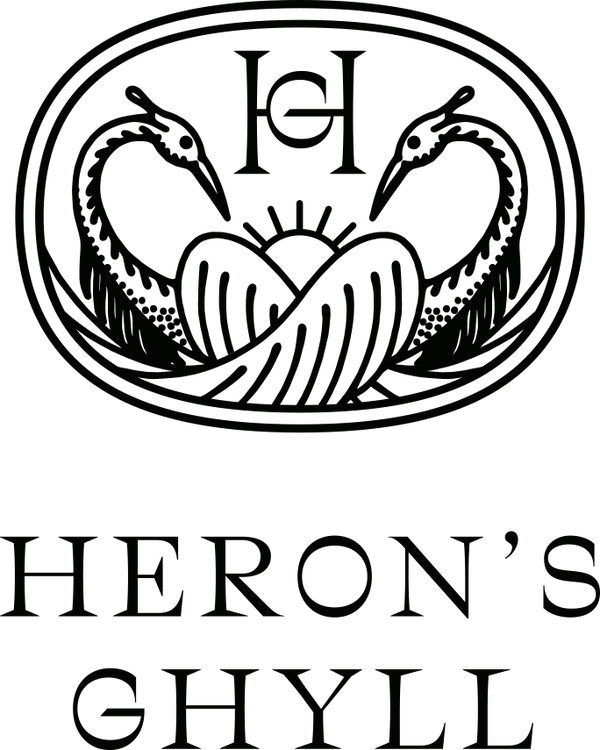
Two marks define Heron's Ghyll:
Twin Herons: Guardians of the Spiky Self
Two herons face each other, not mirror images but counterparts. Between them rests a rambutan, improbable spikes held within the gentle formality of Anglican heraldry. The fruit remains alien, its spikes preserving a wildness no heraldic tradition can civilize.

Heron’s Ghyll showerproof cotton drill garment bag with emblem. Made in England.
The Solitary Heron: Independence & Containment
A lone heron curves into self-possession: neck arched inward, wings folded close, body sealed within the oval boundary. This is the icon of independence—of strength shaped by solitude.
Yet, one detail escapes: the aigrette extends beyond the border, a delicate plume that refuses enclosure. Even when bracing against the world something irrepressible breaks through.

Heron's Ghyll gold foil debossed letterpress business cards. Made in England.
///
The designs draw from a lineage of forms:
English private bank seals
Our approach to nurturing client relationships has its parallels in private banking: intimacy, trust, discretion, and a more long-term view of client servicing. We wanted our logo to be the mark of a longstanding, personal relationship.
Ukiyo-e and linocuts
The English storybooks of my childhood were often adorned with woodcuts—spare, inky etchings of hedgerows and half-timbered cottages—and so the medium, for me, became entwined with a pastoral England I had never seen. Heron’s Ghyll evokes that same imagined landscape.

From left to right: Reuzenreiger (1915) by Samuel Jessurun de Mesquita; Heron (1910) woodcut by Walter Kemm; Two Herons in the Snow (1970) by Gakusui Ide; Great Blue Heron by Linda Jean Thille.